
How to keep a poultry house cool through a Bangladeshi summer
Moving air comes first, cooling pads come second, and humidity decides how much good the pads can do. A practical order of work for April to September.
Birds do not sweat. They lose heat by panting and by letting air carry it off their skin, which is why air speed matters more than the number on the thermometer. Get air moving over the birds first. Add evaporative cooling second. In that order — a cooling pad in a house with weak airflow does very little.
Read the birds before you read the meter
Heat stress shows in the flock before it shows on any display:
- Panting with the beak open, wings held away from the body.
- Birds crowding the walls and the air inlets, leaving the middle of the house empty.
- Feed intake dropping while water intake climbs.
- In layers: thinner shells, then fewer eggs.
If you see this at eleven in the morning, the afternoon will be worse. Act at the first sign, not at the peak.
Step one: move the air
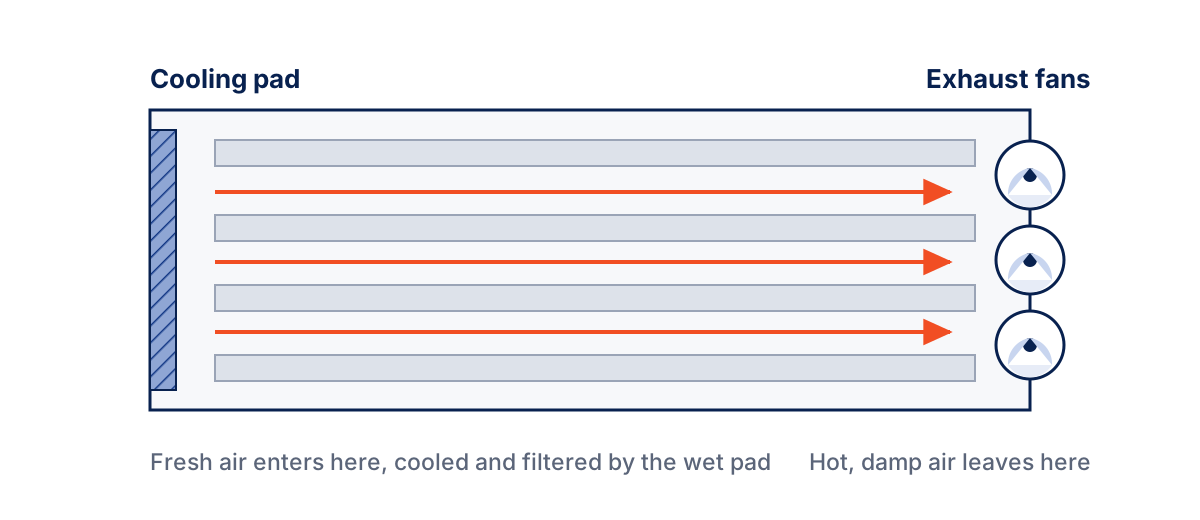
In a tunnel-ventilated house, air enters at one end and every fan sits at the other, so the whole volume of air travels the length of the building and over the birds. That moving air is the cooling — a bird in a 2 m/s breeze is far more comfortable than the same bird in still air at the same temperature.
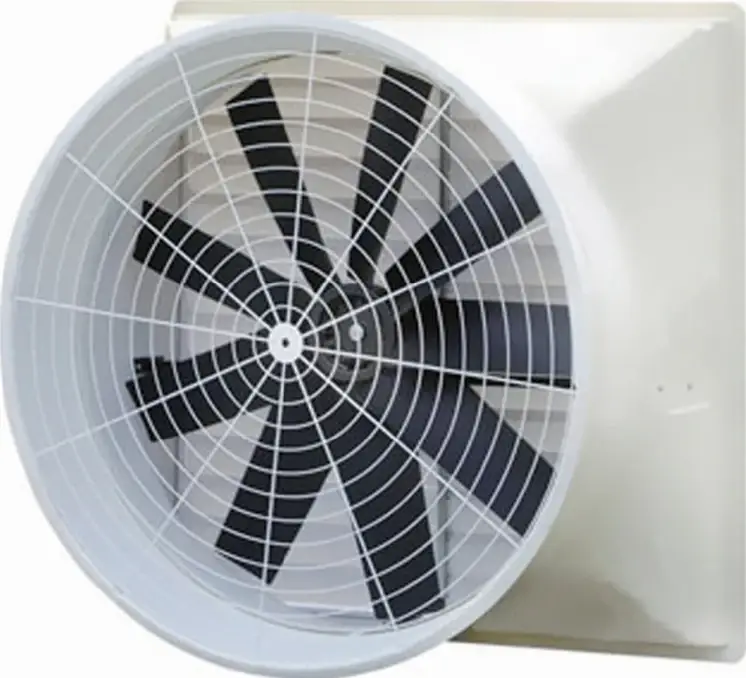
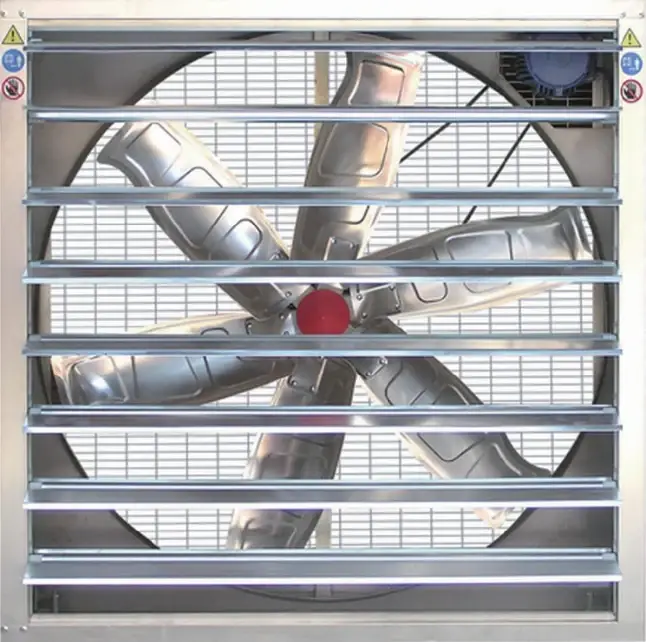
That means your fan wall is the first investment, not the last. Our fiberglass cone fans move 32,000 to 45,000 m³/h each on a 0.75 KW motor, and the drop hammer exhaust fans run from 22,000 up to 52,000 m³/h across six sizes from 30 inch to 55 inch. Which one suits you depends on the size of your house and the air changes you need — that is a calculation, not a guess, and we go through how to do it in choosing an exhaust fan for your poultry house.
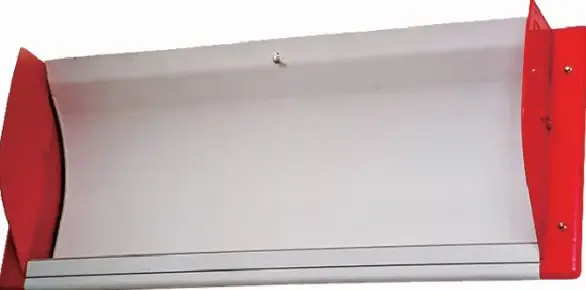
Air also has to get in cleanly. Air inlets with a tight seal when closed and a flexible opening let you control where fresh air enters and stop it short-circuiting straight to the fans. The standard unit is 600 mm wide, 320 mm high and 160 mm thick, with 20 mm of polystyrene insulation in the flap and protective netting outside.
Step two: evaporative cooling
An evaporative pad cools incoming air by making water evaporate into it. Air passes through wet cellulose paper; the water takes heat with it as it turns to vapour; the air arrives cooler.
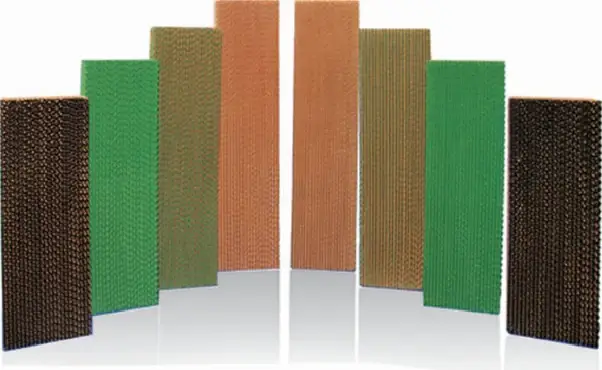
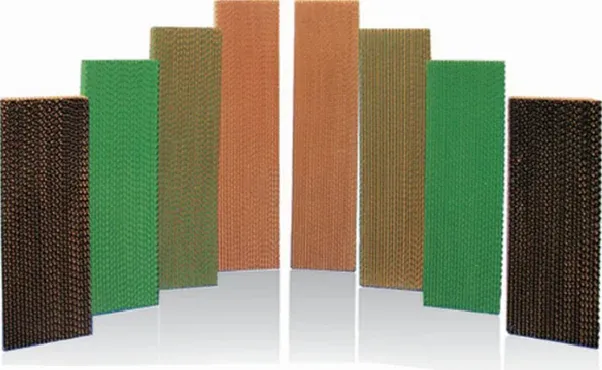
Our cooling pads come in the 7090 and 5090 models, in four colours, on aluminium alloy, stainless steel or hot-galvanised frames. The paper specification is controlled — 85 layers of 600 mm-width paper in the standard build — because thin or uneven paper is exactly where cheap pads fail after one season.
The honest limit: humidity
This is the part most sellers leave out. Evaporative cooling works by putting moisture into the air, so it works best when the air is dry. On a dry, fierce April afternoon in Rajshahi, a pad does a great deal. In a humid August in Khulna, with the air already close to saturated, the same pad does far less — and if you run it hard anyway, you add moisture the birds then have to cope with.
So:
- Run pads hardest in the dry, hot weeks.
- In high humidity, lean on air speed instead, and keep the pads off or on short cycles.
- Never run pads at night in the monsoon just because the day was hot. You will wet the house for no gain.
Step three: let a controller do the watching
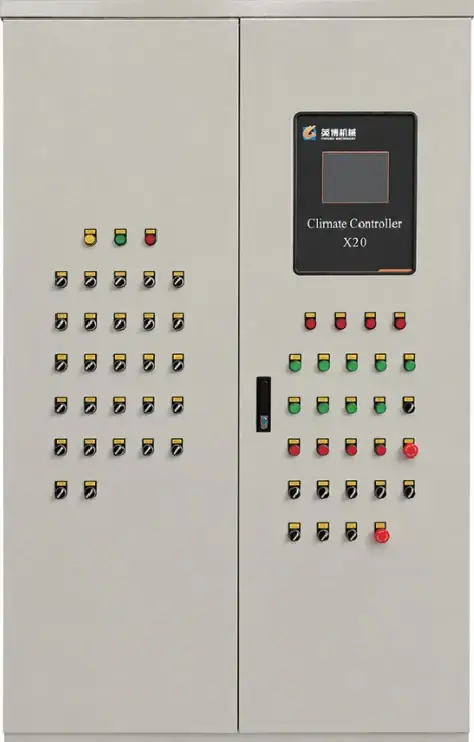
Nobody can adjust fans, pads and inlets correctly at two in the afternoon, at ten at night and at four in the morning, every day, for a whole batch. An environment controller runs the temperature curve, the minimum air volume curve and the light curve, and switches fans, heaters, curtains, pads, lighting and feed lines to match. It handles crosswise and lengthwise ventilation automatically, and it can be watched from a phone — which matters most on the days you are not on the farm.
Maintenance that actually decides whether it works
- Wet the whole pad, evenly. Dry streaks mean hot air is walking straight through. Check the distribution pipe holes are not blocked.
- Keep the water clean. Sediment in the sump ends up in the paper, and hard water leaves scale that blocks it.
- Clean fan blades and shutters. Dust on blades and stiff shutters both cut air volume, quietly, over months.
- Check inlet seals. An inlet that no longer closes is a hole in your ventilation plan all winter.
- Dry the pads before a long shutdown. Paper that is stored wet grows algae and falls apart.
And when the power goes
Every one of these systems stops in a cut. Before summer starts, know exactly which fans your generator can carry, and how long the house stays safe with no fans at all on a still, hot afternoon. In a closed house, that time is shorter than most people expect. Curtain houses have a manual fallback; fully closed houses do not, which is an argument for keeping a manual drop-curtain option even in a modern build.
Send us your house dimensions — length, width, height and whether it is open-sided or closed — and we will tell you what fan and pad combination the building actually needs before the next hot season.