
Choosing an exhaust fan for your poultry house
Cone, butterfly, drop hammer or centrifugal shutter: what the air volume figure means, how many fans a house needs, and the voltage question to settle.
A fan is sold on one number: air volume, written in cubic metres per hour (m³/h). It tells you how much air the fan moves in an hour under test conditions. Everything else — blade size, motor power, the shape of the housing — exists to deliver that number reliably, quietly, and for several years in a damp, dusty, ammonia-heavy building.
Before you compare models, settle three things about your own house.
Three questions to answer first
1. How big is the house, in cubic metres? Length times width times average height. This is the volume of air you need to replace, and the whole calculation starts here.
2. How fast must the air change? In hot weather a broiler house may need the whole volume replaced in under a minute. In cold weather you only need the minimum exchange that keeps ammonia and moisture down. Your fan wall must cover the hot-weather case; your controller handles the rest by running fewer fans.
3. What power do you actually have? Every fan in our range is rated at 380 V — three-phase. If your farm runs on single-phase supply, settle this before anything else, not after the fans arrive. Talk to us and to your electrician together.
The four families, and what each is for
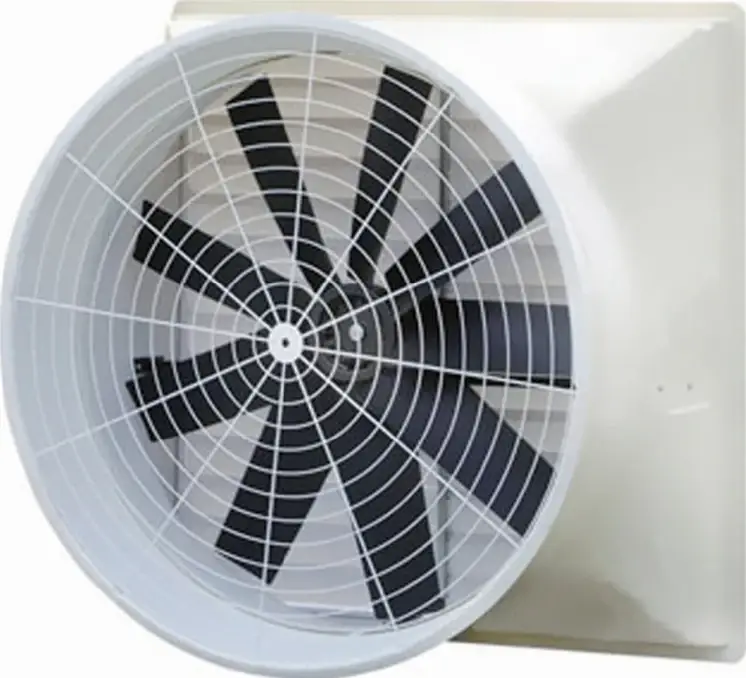
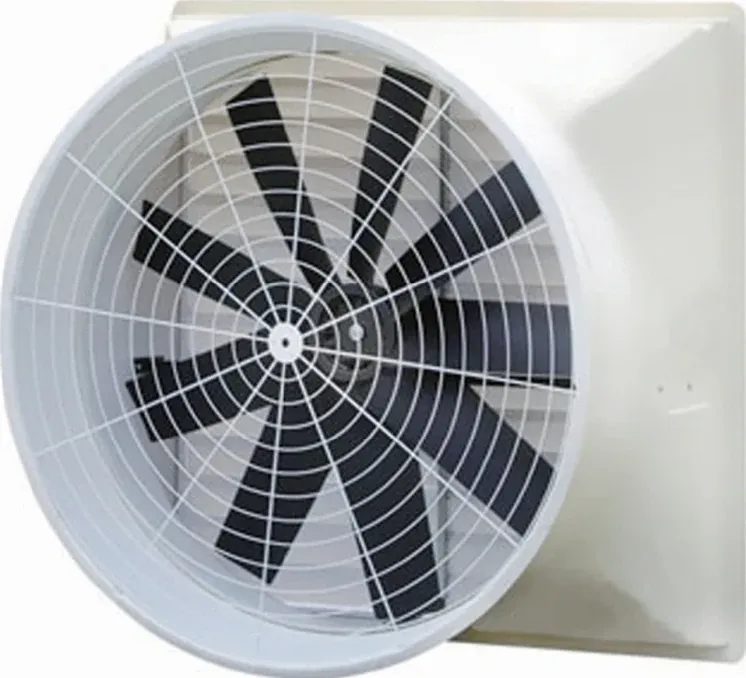
Fiberglass cone fan — the corrosion-proof option. Three frame sizes, 32,000 to 45,000 m³/h, all on a 0.75 KW motor. The largest, BC-148, has a 1250 mm blade turning at 440 rpm in a 1480 by 1480 by 600 mm frame. Fiberglass does not rust, which is why it earns its place at the wet end of a house or on a farm near the coast.
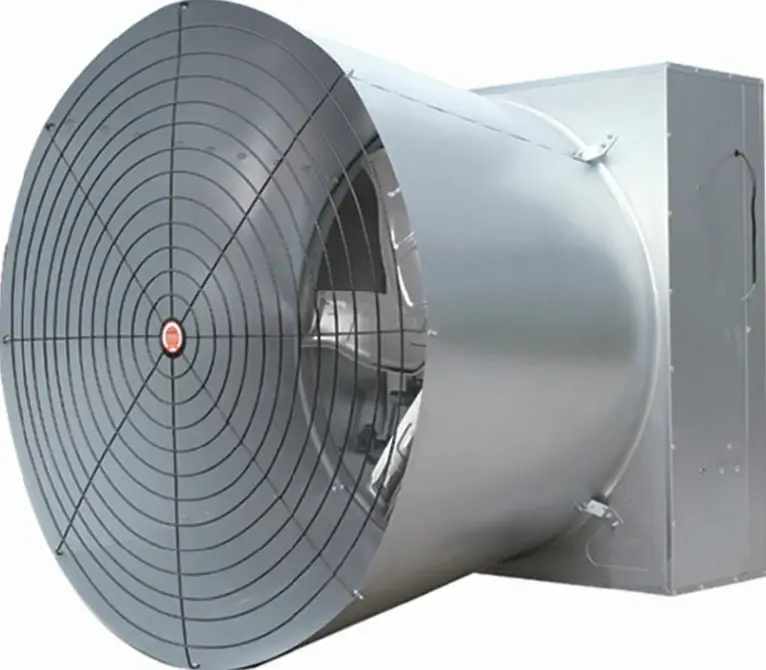
Butterfly cone fan — high volume, low noise, reaching 51,020 m³/h with noise at or below 70 dB. The BC-1100 moves 32,500 m³/h from a 36 inch blade at 600 rpm on 0.75 KW. Worth considering where the shed sits close to houses.
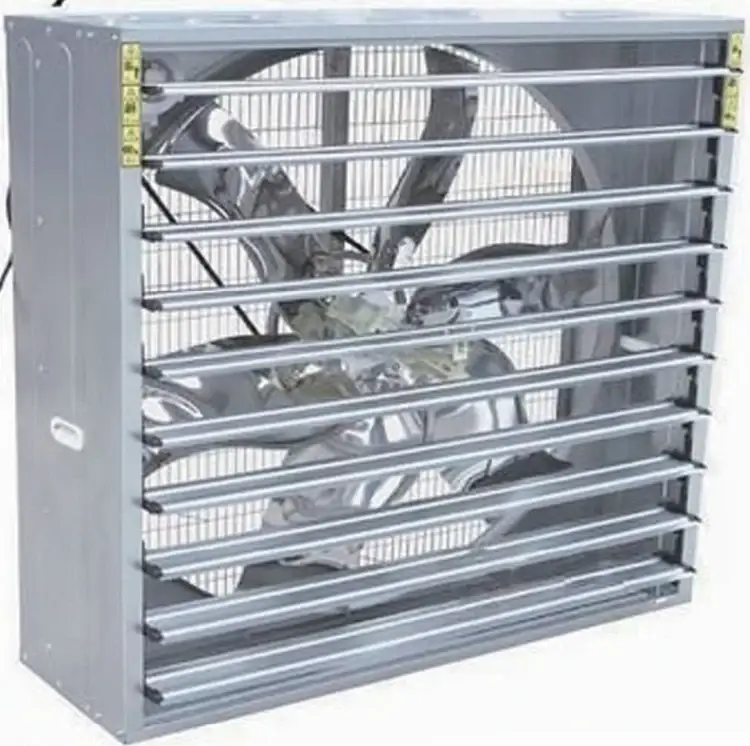
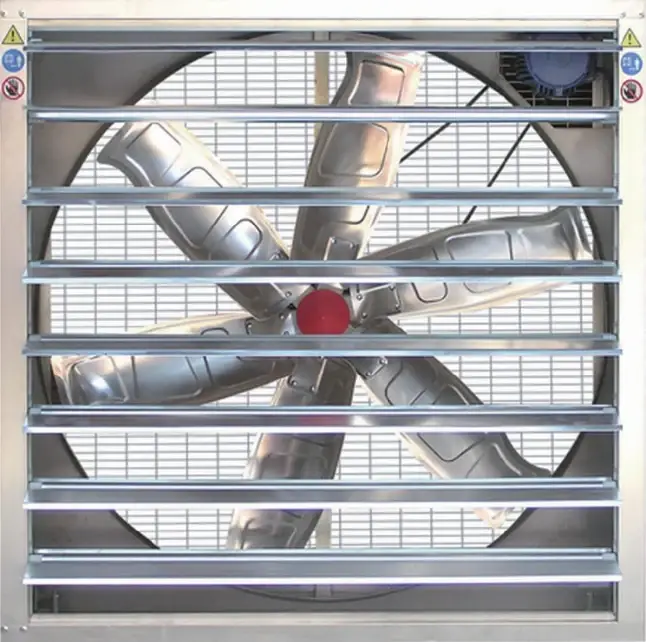
Drop hammer exhaust fan — the widest choice, six sizes from 30 inch to 55 inch covering 22,000 to 52,000 m³/h. The 55 inch BC-1530 gives 52,000 m³/h at 325 rpm on a 1.5 KW motor. When you need to hit a target air volume with a sensible number of units, this range usually has the size that fits.
Centrifugal shutter exhaust fan — galvanised housing, shutters opened by centrifugal action rather than a separate mechanism. Two models, 50 inch and 36 inch, up to 43,170 m³/h. Fewer moving parts at the shutter is one less thing to seize up in a dusty house.
How many fans?
The arithmetic is simple; the inputs are what take care.
- Work out the air volume your house needs per hour in the hottest conditions you plan for.
- Divide by the air volume of one fan.
- Round up, then add one.
That last step is not sales talk. Fans fail, and they fail in the week you need them. A spare unit in the wall — and a spare motor on the shelf — is cheaper than a hot afternoon with a gap in your fan bank.
Two warnings on the arithmetic. Catalogue air volumes are measured at zero static pressure, so a real house with dirty shutters, a half-open inlet and a light trap outside moves less air than the sheet says. And more fans on a badly sealed house fixes nothing: air comes in through the nearest crack instead of travelling the length of the building.
Fans are only half of a ventilation system
The other half is where the air comes in. A fan can only pull. If the inlets are wrong, air arrives at the wrong speed in the wrong place, and the birds nearest the inlet get chilled while the far end stays stale.
Air inlets give you that control: a tight seal when closed, a flexible opening when you want it, 20 mm of polystyrene insulation in the flap, and three hole sizes. Plan inlets and fans as one system, sized together. There is more on how that works in keeping a poultry house cool through a Bangladeshi summer.
What to check before you sign an order
- Voltage and phase. 380 V three-phase, confirmed against your own supply.
- Air volume per fan, and the total after you add your spare.
- Blade diameter and frame size, checked against the wall openings you have or can cut.
- Housing material. Fiberglass or galvanised, depending on how wet and how salty your site is.
- Noise, if you have close neighbours.
- Spares. Motors, shutter parts, fixings. Ask what is held in Dhaka before you need it.
Send us the length, width and height of your house, your bird numbers and your electrical supply, and we will come back with a fan count and a layout rather than a price list.